
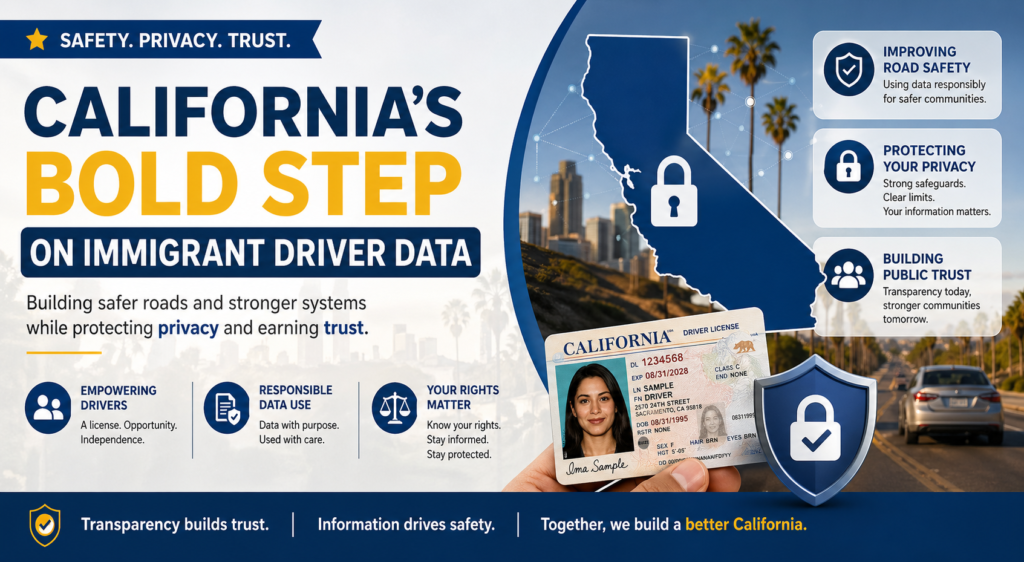
Many people are now trying to understand what California’s Bold Step on Immigrant Driver Data actually means and why it is being discussed so widely. The topic has gained attention because it sits at the intersection of privacy rights, public safety, and digital trust.
For immigrant drivers in particular, a driving license is far more than just an identification card. It represents independence, mobility, and the ability to work and participate in everyday life with stability. When data connected to these licenses is collected or shared, it naturally raises important concerns about how that information is used and protected.
California has introduced a more structured approach to sharing driver-related information. This may include specific records that support safety monitoring, legal verification, or coordination with broader national systems. While the intention is often linked to improving road safety and administrative efficiency, it also leads to growing concerns among individuals about privacy boundaries and data security.
As a result, many people are actively searching terms like “California driver data privacy rules” or “immigrant driver data sharing law California” to find simple and clear explanations. They want to understand who can access their information, under what conditions it is shared, and what safeguards are in place to protect it.
Data sharing itself is not a new concept, but the sensitivity increases significantly when personal identity and immigration-related status are involved. Trust becomes the central factor. When individuals feel confident that their data is handled responsibly, they are more likely to engage with systems. However, when transparency is lacking, uncertainty and fear tend to grow.
This is why California’s approach is often described as bold. It attempts to balance two important priorities: public safety and responsible data usage. However, achieving this balance requires strong policies, clear communication, and reliable safeguards that ensure people fully understand how their information is being handled.
Why This Decision Matters in Today’s Digital Era
The importance of California’s Bold Step on Immigrant Driver Data becomes even more clear when viewed in today’s digital world. We now live in an era where almost every interaction generates data—whether it is filling out a form, applying for a license, or using online services.
This constant flow of information makes data both valuable and sensitive. While it can improve systems and decision-making, it also raises serious concerns about privacy and misuse.
For immigrant drivers, the issue carries additional weight. Many individuals already approach data-sharing systems with caution due to past experiences or uncertainty about regulations. Any change in policy can increase concerns about how their personal information might be accessed or shared beyond its original purpose.
At the same time, government systems aim to improve efficiency and safety. Shared driver data can help reduce fraudulent activities, track violations more effectively, and strengthen road safety systems. In urgent situations, having access to accurate information can also support faster decision-making.
This is why users often search for queries like “is driver data shared in California” or “DMV privacy rules USA explained.” Their goal is not legal complexity but clear, practical understanding of how these policies affect them directly.
Another critical aspect is public trust. When people trust a system, they participate in it more confidently. When that trust weakens, hesitation and resistance increase. This can influence everything from license applications to compliance with transportation rules.
Ultimately, the challenge is not just about collecting or sharing data. It is about establishing clear limits, maintaining transparency, and ensuring accountability at every stage of data handling.
Impact on Drivers and Everyday Life
The real-world impact of California’s Bold Step on Immigrant Driver Data becomes more visible in everyday experiences rather than in policy documents.
For many drivers, the change may not appear immediately significant. However, over time, it influences how they perceive privacy, safety, and government systems.
People frequently search questions like “can my driving record be shared” or “how secure is DMV data in California” because they want to understand their level of risk and control. This reflects a growing awareness of digital privacy among everyday users.
For immigrant drivers, the emotional and practical impact can be even greater. A driving license often supports essential aspects of life such as employment, transportation, and family responsibilities. Any perception of data vulnerability can therefore affect their sense of security and confidence.
On the positive side, improved data systems can also bring meaningful benefits. Better coordination can reduce errors in records, improve traffic management, and support law enforcement in more efficient and fair ways. When implemented properly, data-sharing systems can contribute to safer roads and more reliable governance.
However, the key concern remains control and transparency. Drivers want to know whether they have any influence over how their data is used and whether their rights are fully protected under these systems.
Searches like “driver data protection laws USA” or “privacy rights for immigrants in California” show that people are actively trying to educate themselves and safeguard their personal information.
In daily life, the impact largely depends on how clearly these systems are explained. Transparent communication helps people adjust more easily, while unclear policies can lead to confusion, stress, and hesitation.
Lessons for Businesses and Digital Systems
California’s approach to driver data also provides important lessons for businesses and digital platforms that rely heavily on user information.
In today’s digital economy, data is not just a technical resource—it represents real individuals with real concerns. How organizations collect, store, and use data directly influences user trust and long-term relationships.
Modern users are increasingly aware of their digital footprint. Many search queries like “how companies use my personal data” or “is my online data safe” reflect a shift toward greater awareness and caution.
For businesses, this means transparency is no longer optional. Clear communication, simple privacy policies, and honest explanations of data usage are essential for building trust.
Another important lesson is adaptability. As user expectations evolve, systems must also evolve. Practices that were acceptable in the past may no longer meet today’s standards for privacy and accountability.
Security also plays a critical role. Strong protection mechanisms are necessary to prevent breaches and maintain credibility. Even minor data mishandling can significantly damage user trust and brand reputation.
Additionally, user education is becoming increasingly important. When individuals understand their rights and how their data is handled, they are better equipped to make informed decisions. This creates a healthier and more transparent digital ecosystem.
Ultimately, success in the digital age is not just about collecting data efficiently. It is about using it responsibly, ethically, and transparently.
Final Thoughts: Trust, Data, and the Future
California’s Bold Step on Immigrant Driver Data represents more than a policy adjustment. It reflects a broader global shift in how data is collected, shared, and protected in a rapidly digitalizing world.
For drivers, especially immigrants, the situation brings both opportunity and concern. While improved systems can enhance safety and efficiency, they also raise valid questions about privacy and long-term data protection.
Modern users are no longer passive participants. They actively seek clarity, ask questions, and expect accountability. Their demand is simple: they want to know that their information is handled with care and respect.